
ABOUT US
Your Expert Manufacturer of Wedge Wire Screens;
Your Reliable Partner and Source of Innovation
GET A FREE QUOTE
-
Home

-
Blog
-
Industry Blog
- Sieve Bend Screen Capacity in Mineral Slurry Applications
Sieve Bend Screen Capacity in Mineral Slurry Applications
-
 author
 - 17,septiembre
A slurry line can deliver more flow while leaving its discharged solids wetter. For mineral processing teams, that is the difficulty with sieve bend screen capacity: the useful limit depends on the separation achieved, as well as the feed accepted. Understanding how slurry crosses the curved panel helps explain why two screens with similar dimensions can perform differently.
Capacity depends on the separation duty
A sieve bend screen removes liquid and some fine particles as slurry travels across its curved surface. Coarser material continues toward the discharge. In tailings pre-dewatering, the useful result is less water accompanying retained solids. In classification, the size distribution of both outgoing streams matters. These duties can produce different capacity limits on the same panel.
Capacity figures need a clear measurement basis. A slurry flow in cubic metres per hour includes liquid and solids; dry tonnes per hour measures only solids. A rating per metre of screen width also differs from the total flow through an assembly. Comparing these figures without their units and feed conditions can create a misleading impression of spare capacity.
Feed distribution controls the width doing the work
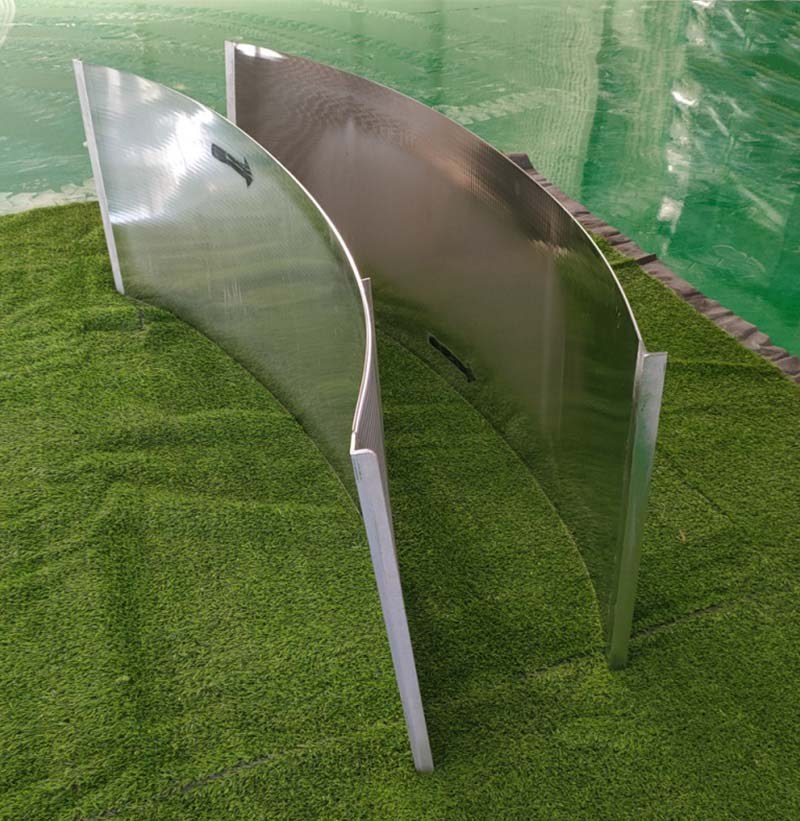
The separation mechanism depends on slurry arriving tangentially and spreading across the upper screen. Flow crosses the profile wires and slots, allowing successive wire edges to remove layers of liquid and undersize material. The feed box therefore influences how much of the screen can contribute to separation.
Uneven feeding concentrates the load into a smaller working width. A heavy stream down the centre can coexist with lightly loaded edges. Increasing the total feed in that condition intensifies local loading before the full panel is effectively used. Checking the distribution across the entry lip is a useful first response when discharge becomes unexpectedly wet.
Feed velocity belongs in the same assessment as distribution. A different feed head or gate setting changes how slurry reaches the arc, so a capacity figure established under one inlet condition cannot automatically describe another. A wider replacement panel needs an inlet arrangement that spreads the additional flow across that width.

Solids concentration changes the load behind the flow
Equal slurry volumes can carry very different solids loads. As an illustrative calculation, 100 cubic metres per hour at a measured slurry density of 1.2 tonnes per cubic metre and 20% solids by mass contains 24 dry tonnes per hour. The calculation is volume flow multiplied by slurry density and solids mass fraction; these values are assumptions, not a screen rating.
Particle size distribution also affects the separation that remains achievable at a given feed rate. A stream rich in fine particles behaves differently from a coarser feed, even when both have the same solids percentage. Clay content and slurry flow behaviour deserve attention when operating results change after a change in ore feed.
Dilution changes both sides of the capacity problem. Adding water reduces the solids concentration but increases the liquid volume that must be handled. It should therefore be judged against the measured separation result and downstream water load. A lower solids percentage alone does not establish that the circuit can accept more dry tonnes.

Slots and the curved surface set different limits
The wedge wire screen provides continuous openings between supported profile wires. Slot width and wire width together influence the available drainage area. Opening the slots can increase drainage, but it also changes which particles pass through. A capacity improvement that sends valuable retained material into the undersize stream may undermine the purpose of the screen.
The curved path adds another design variable. Radius and wrap angle determine the developed arc length, while the screen width determines how broadly the feed can spread. Longer arcs can be relevant to feeds with a high solids content. Width, length and slot opening therefore need to be considered together, rather than reduced to one overall panel area.
Mineral slurry duties require the curved geometry to suit the intended classification or dewatering result. BTOSLOT offers stainless steel sieve bends for tailings dewatering, cyclone underflow classification and slurry thickening, with customizable slots. This makes the curved screen a relevant component to assess against the actual feed and separation objective.
A useful capacity check follows both outlet streams
An operating trial establishes sieve bend screen capacity more meaningfully when feed and separation are recorded together. At each stable feed condition, compare the water carried with retained solids and the particles reporting to the undersize. Increasing throughput is useful only while those results remain acceptable for the process.
Screen condition must remain part of that comparison. Deposits can obscure drainage openings, while wear changes the working wire edges. Comparing a clean panel with a worn or partly blinded panel can make a feed change appear responsible for a loss that has another cause. Record panel condition before interpreting the trial.
A representative trial should include the feed variation the plant actually encounters. Keep separate records for materially different solids concentrations or ore conditions instead of averaging them into one reassuring number. The resulting operating range is more useful than a peak flow observed briefly under favourable conditions.
The operating window matters more than peak flow
Useful capacity is the flow a sieve bend can process while preserving its intended separation. Even feeding makes the width available; slurry characteristics determine the load; slots and curvature govern how that load separates. Evaluate those conditions together, then confirm the operating range from both discharge streams before increasing plant throughput.
FAQ
What is the capacity of a sieve bend screen?
There is no single capacity for all sieve bends. The applicable figure depends on width, slot opening, wire profile, feed conditions and the required separation. Confirm whether a stated rate refers to slurry volume, dry solids or flow per unit width.
Does doubling screen width double capacity?
Additional width provides more parallel screening surface, but proportional capacity requires comparable loading and effective feed distribution. A narrow inlet stream can leave much of the extra width underused.
Can wider slots increase throughput?
Wider slots can improve drainage, but they also affect particle passage. Check the undersize and retained product before treating increased flow as a process improvement.
Why does capacity fall when the ore feed changes?
Changes in solids concentration, particle sizes and flow behaviour can alter separation at the same volumetric feed rate. Check these alongside feed distribution and panel condition.
Does a static sieve bend need a motor?
The static screen has no driven screening motion; it uses the incoming slurry’s energy and gravity. Pumps or other equipment supplying the feed can still consume power, so the complete circuit is not necessarily energy-free.
Recent Post

Related Products
Best-selling Products
Starch Screen
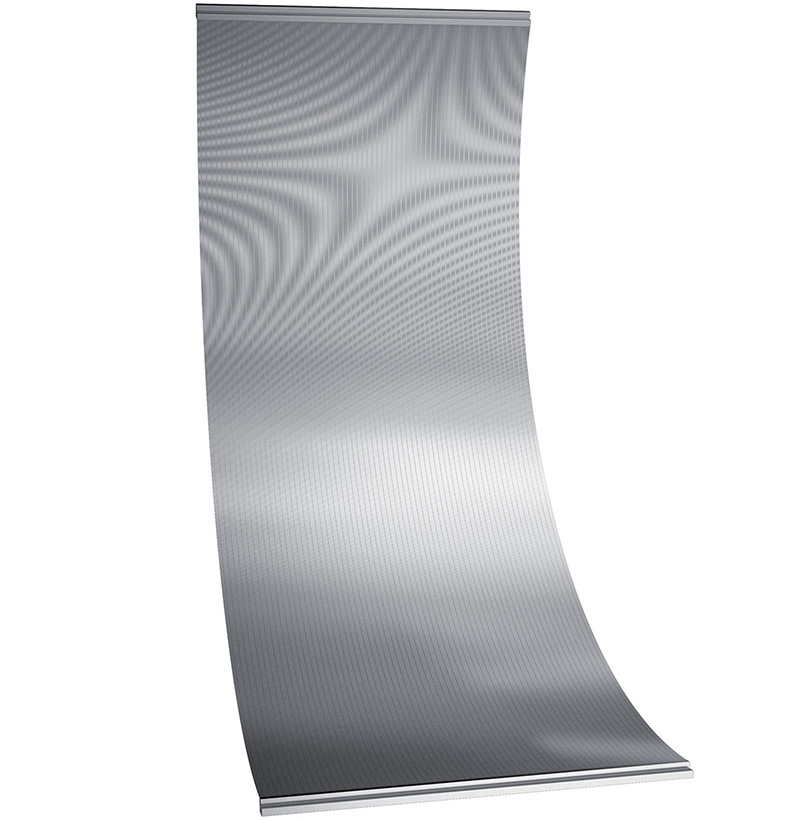
The Wedge Wire Starch Curved Screen is a curved screening device specifically designed for the starch industry. It features an arc-shaped screen surface made of precisely welded V-profile stainless steel wires, utilizing centrifugal force or gravity to achieve rapid dewatering and classification of starch slurry. Its curved structure prolongs slurry retention time, improving solid-liquid separation efficiency. It is suitable for starch extraction, refining, and byproduct recovery processes for starches such as potato, corn, and cassava. Characterized by efficient screening, wear and clogging resistance, and easy maintenance, this equipment is a key solid-liquid separation device in modern starch processing.
Rotary Drum
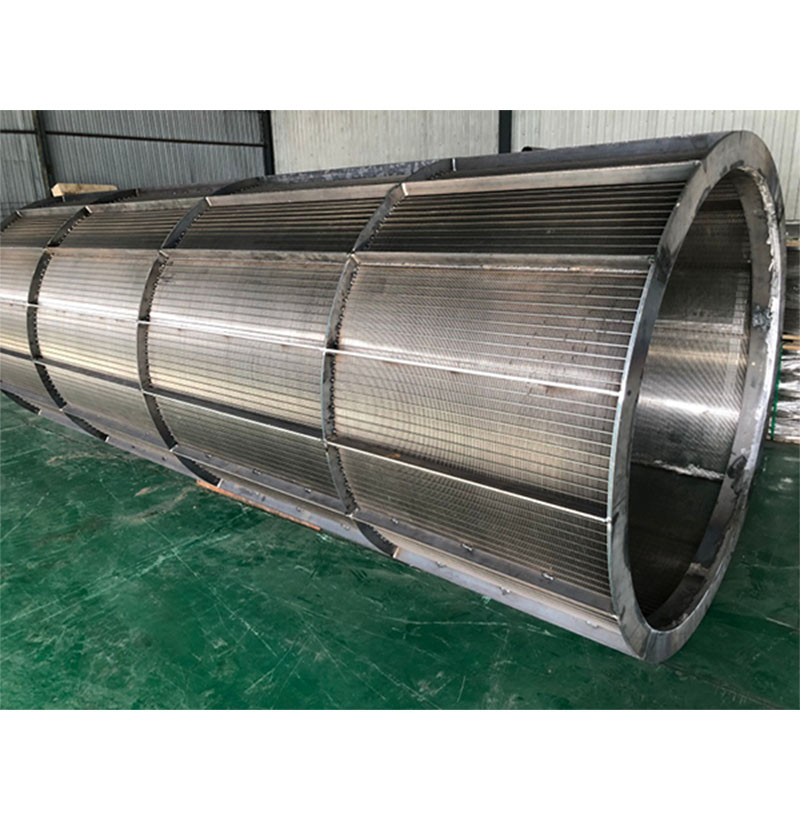
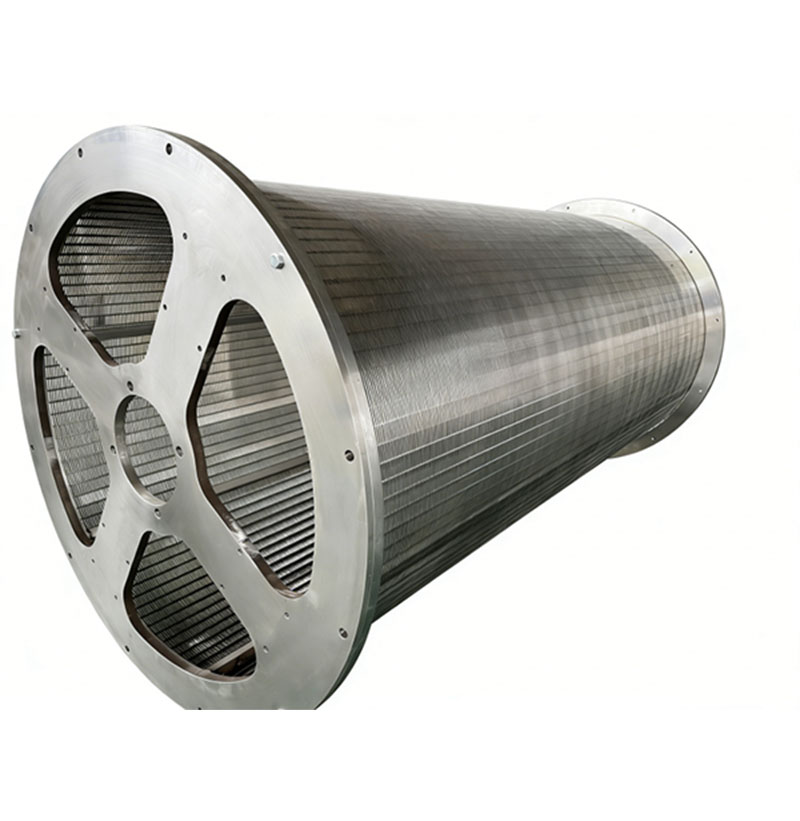
The Stainless Steel Wedge Wire Rotary Drum Screen (also known as a Rotary Drum Strainer or Micro-Screen) is a continuously and automatically operating front-end solid-liquid separation device. Its core component is a large cylindrical drum installed horizontally or at a slight incline. The entire circumferential surface of the drum is covered with a stainless steel wedge wire screen (Johnson screen). The wastewater to be treated flows into one end of the drum. Under gravity, the filtrate passes through the wedge wire slots, while solid suspended matter (such as fibers, hair, plastic pieces, and fine particles) is retained on the inner surface of the drum. As the drum rotates slowly, the retained debris is lifted to the top, where it is flushed by spray water into a collection trough, achieving a continuous process of automatic screening, filtration, and residue removal
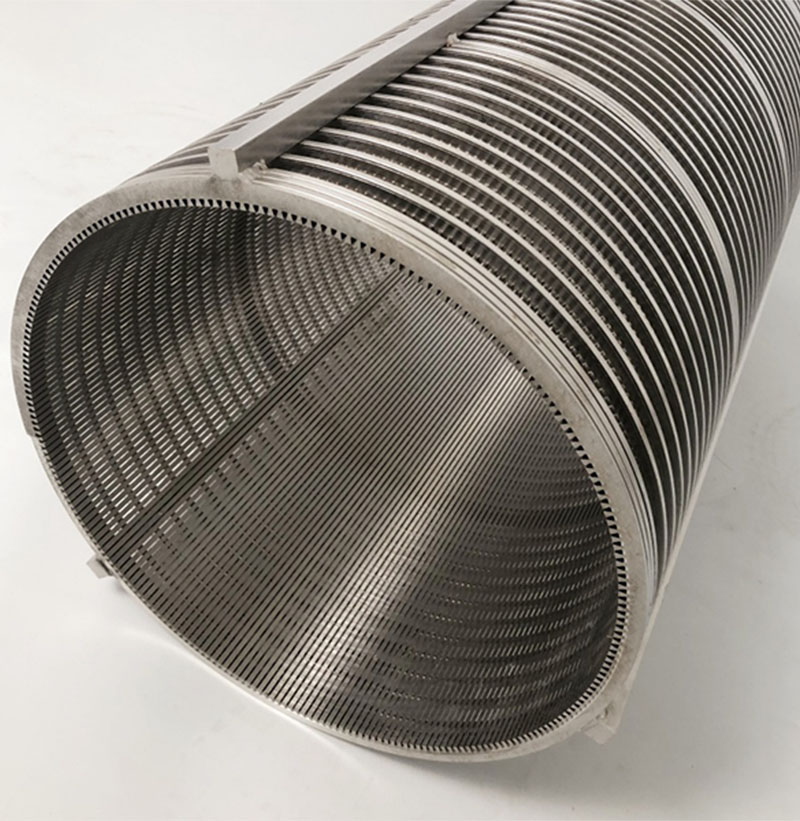
Screen Basket for Screw Press Separator
The stainless steel wedge wire screen basket, commonly known as the "V-wire screen," "press screen basket," or "screen cylinder," is a core component of screw press solid-liquid separators. It is installed inside the spiral press, enclosing the rotating screw shaft. The working principle is as follows: raw slurry with high moisture content is pushed into the screen basket by the screw shaft. Under the squeezing and conveying action of the spiral flights, the liquid (filtrate) is forced out through the precise, continuous slots of the screen basket, while the solid material (manure cake) is retained inside and continues to be compressed and dewatered as it moves forward. Finally, the dewatered solids are discharged from the outlet, achieving solid-liquid separation.
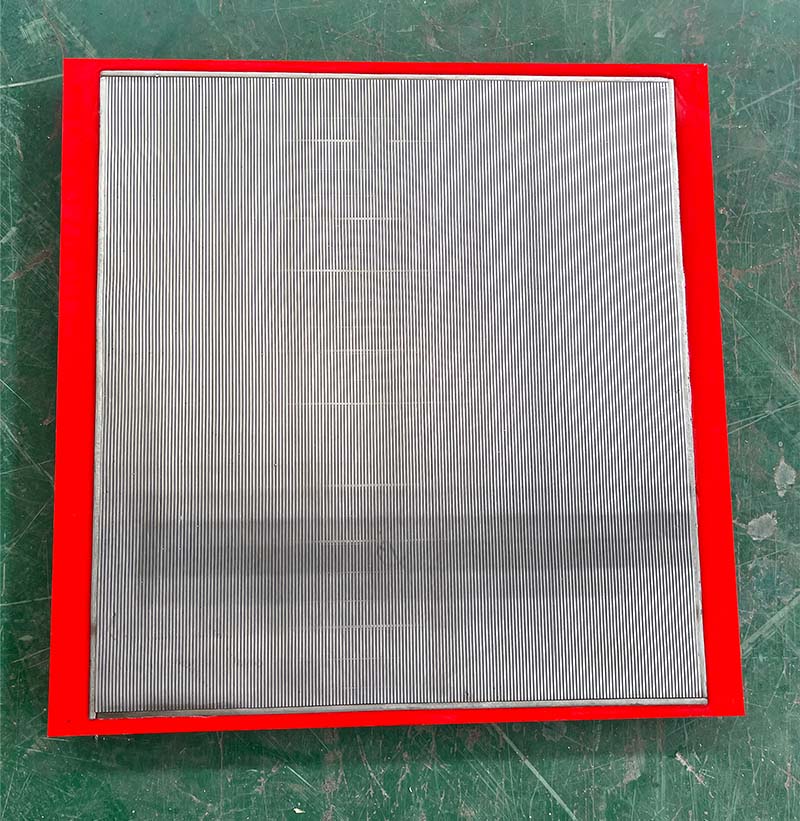
Wedge Wire Vibrating Screen
A stainless steel wedge wire vibrating screen is a solid-liquid separation device featuring a screen surface made by precisely welding V-shaped stainless steel wires, integrated with a high-frequency vibration system. With uniform slots, wear resistance, and corrosion resistance, it is suitable for wet screening and dewatering operations. The vibration mechanism enables rapid material dispersion and efficient sieving while effectively preventing screen clogging. Widely used in industries such as mining, metallurgy, food processing, and environmental protection, it is particularly suitable for handling fine particles, high-viscosity, or easily agglomerated materials, offering advantages such as high screening accuracy, large processing capacity, and long service life.
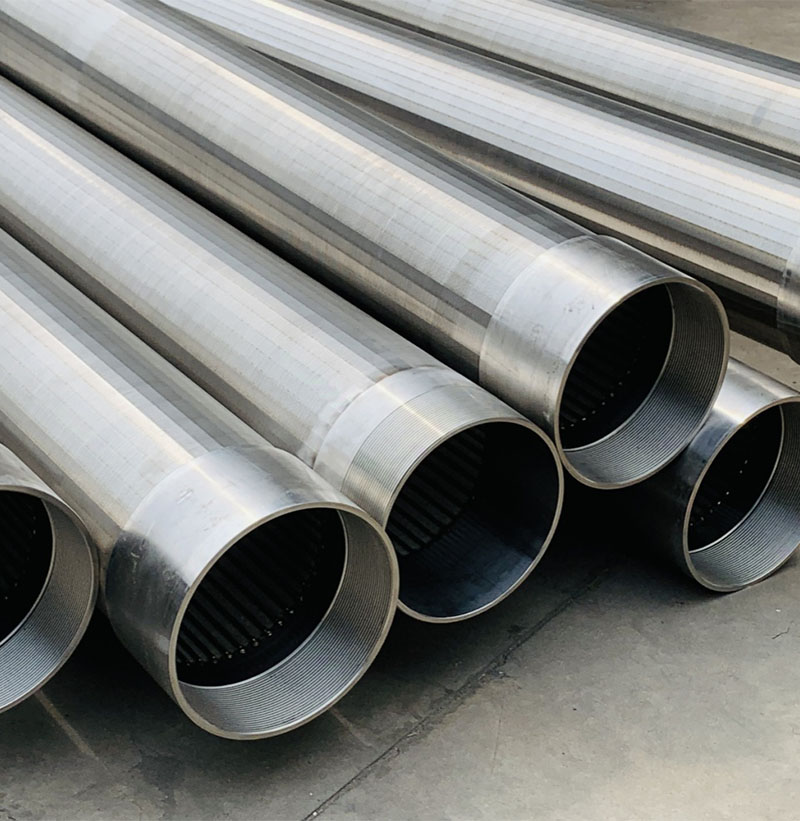
Wedge Wire Water Well Screen
Johnson Deep Water Well Screens, also referred to as continuous slot screens or wire wrap screens, were originally developed to solve sand control challenges in fine-grained and uniform sand formations. These geological conditions are commonly encountered in deep groundwater aquifers, where conventional perforated pipes often suffer from clogging, excessive sand production, and reduced well efficiency.
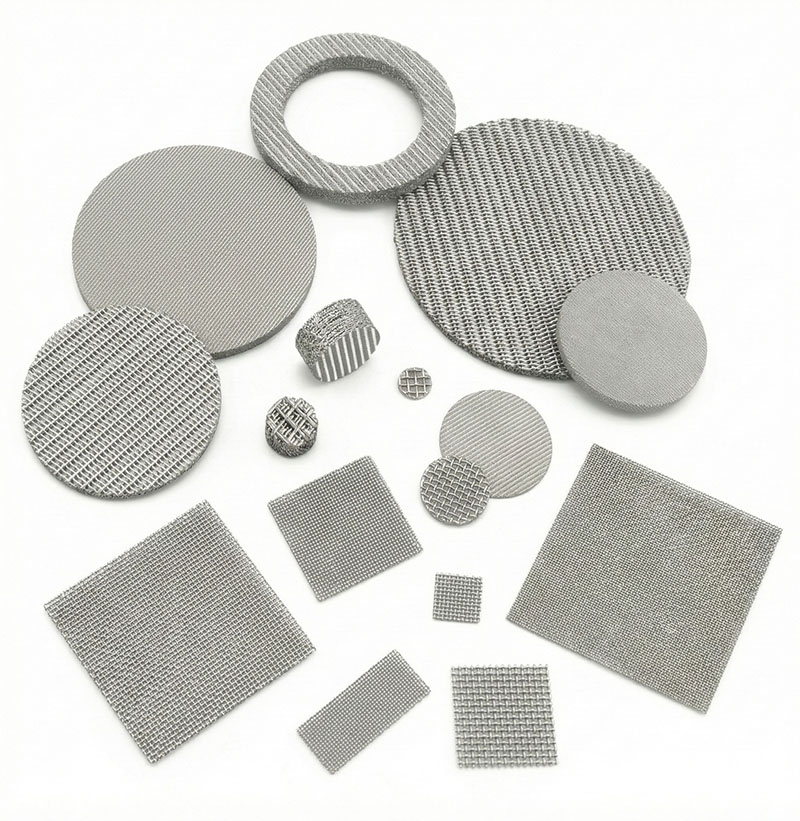
Sintered Mesh Plate and Disc
Sintered Mesh Plates and Discs are high-precision filtration components fabricated by bonding multiple layers of stainless steel wire mesh through a specialized vacuum sintering process. Unlike traditional mesh that relies on mechanical weaving alone, these plates are fused at every contact point, transforming individual wires into a rigid, integrated porous metal sheet.
These plates can be customized into various shapes, most commonly circular discs, to fit specific industrial equipment. They offer an ideal balance of high permeability, extreme structural integrity, and precise filtration ratings. Because they are made entirely of metal (typically 304 or 316L), they provide a "permanent" filtration solution that can withstand high temperatures and corrosive chemicals while remaining fully cleanable and reusable.