
À propos de nous
Votre fabricant expert d'écrans de fil de coin;
Votre partenaire fiable et source d’innovation
Obtenez un devis gratuit
-
Accueil

-
Blog
-
Blog de l'industrie
- Why Use Sieve Bend Screens for Mineral Slurry Pre-Dewatering?

Why Use Sieve Bend Screens for Mineral Slurry Pre-Dewatering?
-
 auteur
 - 3,septembre
 auteur
A dewatering circuit can lose stability before its main equipment fails. When mineral slurry carries more free water than the next stage can handle, the result is often a thin, uneven feed and a harder job downstream. A sieve bend gives that water an earlier path out, helping the circuit receive a more manageable stream.
The downstream problem begins with excess free water
Pre-dewatering matters because downstream equipment works best when the feed has a reasonably consistent solids loading. Excess free water occupies volume without contributing recoverable solids, so it can spread material across a larger area, reduce residence time, and make moisture control less predictable. The issue is not simply that the slurry is wet; it is that the water arrives in the wrong part of the circuit.
A sieve bend is useful when the process needs an early gravity-driven split rather than a final dry product. In mineral slurry dewatering, its role is to remove water and fine material before the stream reaches equipment designed for a more concentrated feed. The practical question is where a static screen can relieve the next stage without pretending to replace it.
How the curved screen removes the first water
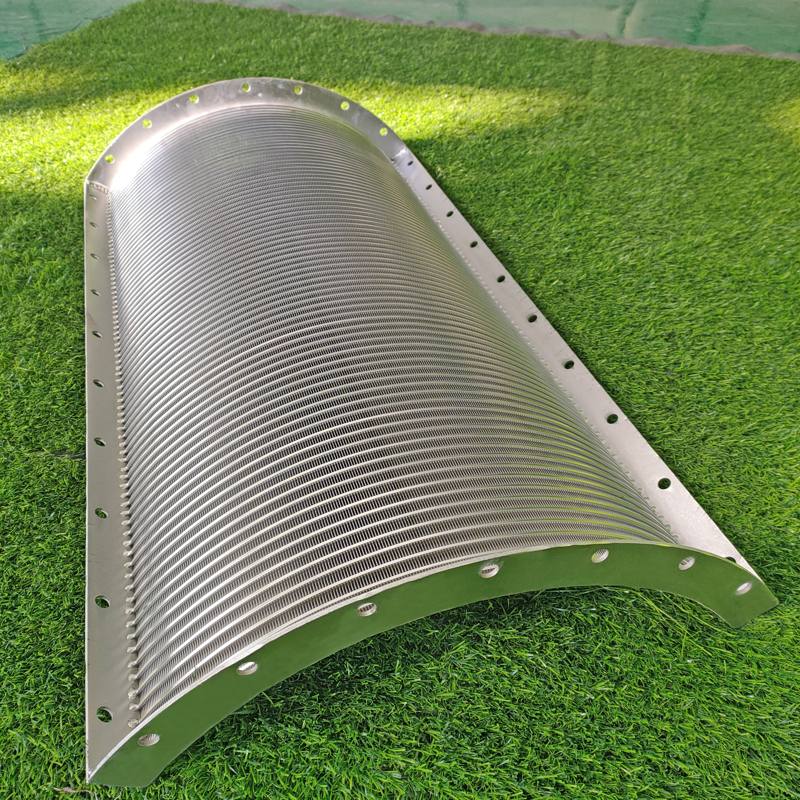
A sieve bend screen receives slurry tangentially across a concave surface. As the stream follows the curve, liquid and suitably small particles pass through continuous slots, while the coarser fraction continues to the discharge edge. The separation is driven by feed momentum, the screen geometry, and gravity, so the screen needs no powered vibration of its own.
The important effect is progressive drainage, not a single all-or-nothing cut. Each section of the curved face has another opportunity to peel away a thin liquid-rich layer. The remaining stream becomes less fluid as it travels, which is why a well-fed static arc wedge wire screen can reduce hydraulic load before a dewatering screen, cyclone, or other concentration step.

Why wedge-wire geometry suits a flowing slurry
The screen face must let liquid escape without turning every near-size particle into a blockage risk. A écran à fil triangulaire uses V-profile wires with continuous openings rather than isolated punched holes. The widening space below the narrow slot helps particles that enter the opening avoid becoming tightly trapped, while the welded support structure keeps the slot pattern stable under normal service.
That geometry does not make blinding impossible. Sticky fines, clay, poor feed distribution, or a slot selected too close to the dominant particle size can still reduce drainage. Its value is that the screen surface is built around a flowing, self-releasing path, giving operators a more forgiving starting point than a surface full of discrete holes.
Feed conditions decide whether pre-dewatering pays off
Water split and solids loading
Feed consistency determines how much useful work the arc screen can do. A slurry with abundant free water and a controllable flow profile can shed liquid readily, whereas a very dense or highly viscous stream may ride the surface with less drainage. Mineral slurry dewatering therefore starts with actual solids concentration and flow behavior, not an assumed performance number.
Slot selection and the real cut point
Slot width is a control point, but it is not the same as the plant’s final separation size. Particle shape, near-size material, feed velocity, screen radius, and the amount of fine solids all affect what travels through the slots. For that reason, a sieve bend screen capacity discussion must include the slurry itself as well as the width and arc of the screen.
-Use representative particle-size data, including the near-size fraction rather than only a top-size figure.
-Check whether the feed box can distribute slurry evenly across the screen width.
-Set the pre-dewatering target: lower hydraulic load, more solids concentration, or a specific water split.
What the next dewatering stage receives
The gain from a sieve bend is easiest to judge at the handoff. A successful pre-dewatering step delivers less free water while preserving a feed character that the downstream machine can handle. It should not be assessed as a stand-alone screen, because the useful result is a calmer and more appropriate feed to the equipment that follows.
| Circuit condition | What the sieve bend changes | What to confirm downstream |
| High free-water load | Removes part of the liquid before the main dewatering duty | Feed depth and hydraulic capacity |
| Uneven slurry distribution | Exposes a feed-box problem rather than hiding it | Whether the screen width is used evenly |
| Large near-size fraction | Makes actual passage behavior more sensitive than slot size alone | Filtrate solids and recovery target |
| Abrasive service | Places wear attention on the curved face and slot stability | Inspection interval and change in process cut |
A static screen has a specific place in the circuit
A sieve bend is most useful when it is assigned a clear upstream task: reduce water early, make a preliminary classification, or prepare a feed for a more intensive dewatering machine. It is less useful when expected to deliver the final moisture result by itself. Keeping that division clear prevents a sound screening choice from being judged against the wrong duty.
Once the plant has defined its feed rate, solids behavior, desired split, and physical space, BTOSLOT, a slurry screen manufacturer, can relate those operating details to a curved wedge-wire configuration. That conversation is most productive when it begins with the process objective instead of a slot size alone.

The practical takeaway
Sieve bends earn their place ahead of dewatering equipment by making the first water split simple and purposeful. Their curved, static wedge-wire surface can reduce hydraulic load, while the final moisture and recovery target remain the responsibility of the full circuit. Treat the screen as a pre-dewatering stage, verify it against real slurry behavior, and it becomes a useful bridge between a wet feed and a more controllable downstream operation.
FAQ
Does a sieve bend replace a dewatering screen?
No. A sieve bend usually performs an early gravity-driven water split or classification step. It can make the feed easier for a dewatering screen to process, but the downstream machine remains responsible for the later-stage moisture target.
What mineral slurries are good candidates for pre-dewatering?
Slurries carrying appreciable free water and requiring a more concentrated feed for the next operation are common candidates. The practical fit depends on particle-size distribution, solids concentration, viscosity, and the value of solids that may report to the filtrate.
Is the slot opening the same as the separation size?
No. The observed cut is affected by particle shape, feed velocity, near-size material, and the curved screening path. Slot width is an essential design input, but plant testing or representative process data is needed to predict separation behavior.
Article récent
Produits connexes
Produits les plus vendus
écran amidon
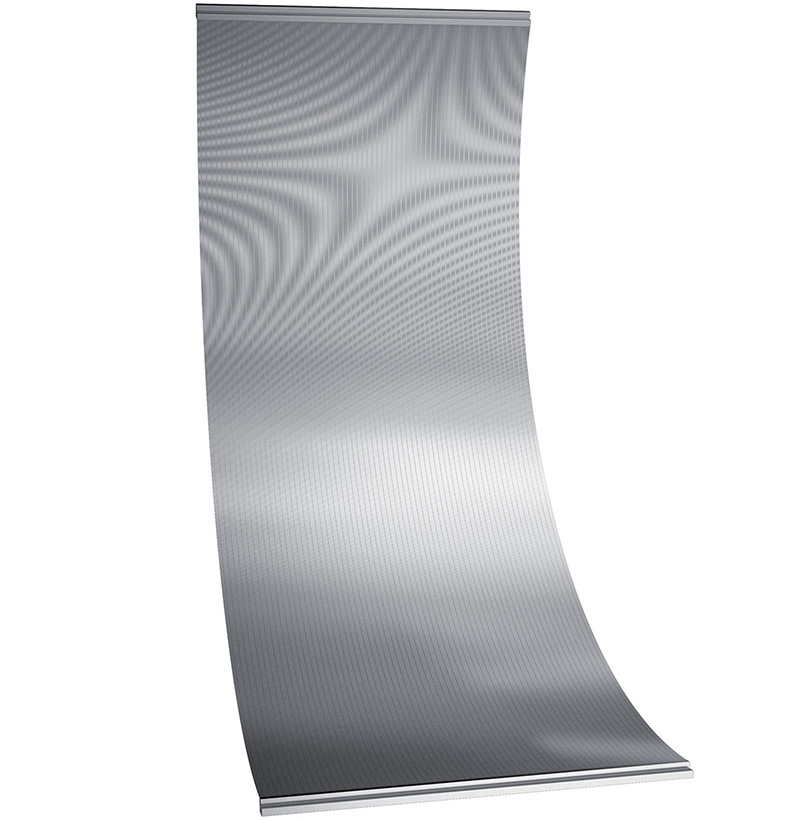
Le Wedge Wire Starch Curved Screen est un dispositif de criblage courbé spécialement conçu pour l'industrie de l'amidon. Il dispose d'une surface d'écran en forme d'arc faite de fils en acier inoxydable en profil V soudés avec précision, utilisant la force centrifuge ou la gravité pour réaliser une déshydratation rapide et la classification de la boue d'amidon. Sa structure courbe prolonge le temps de rétention des boues, améliorant l'efficacité de la séparation solide-liquide. Il convient pour l'extraction d'amidon, le raffinage et les processus de récupération de sous-produits pour les amidons tels que la pomme de terre, le maïs et le manioc. Caractérisé par un criblage efficace, une résistance à l'usure et à l'obstruction et une maintenance facile, cet équipement est un dispositif de séparation solide-liquide clé dans le traitement moderne de l'amidon.
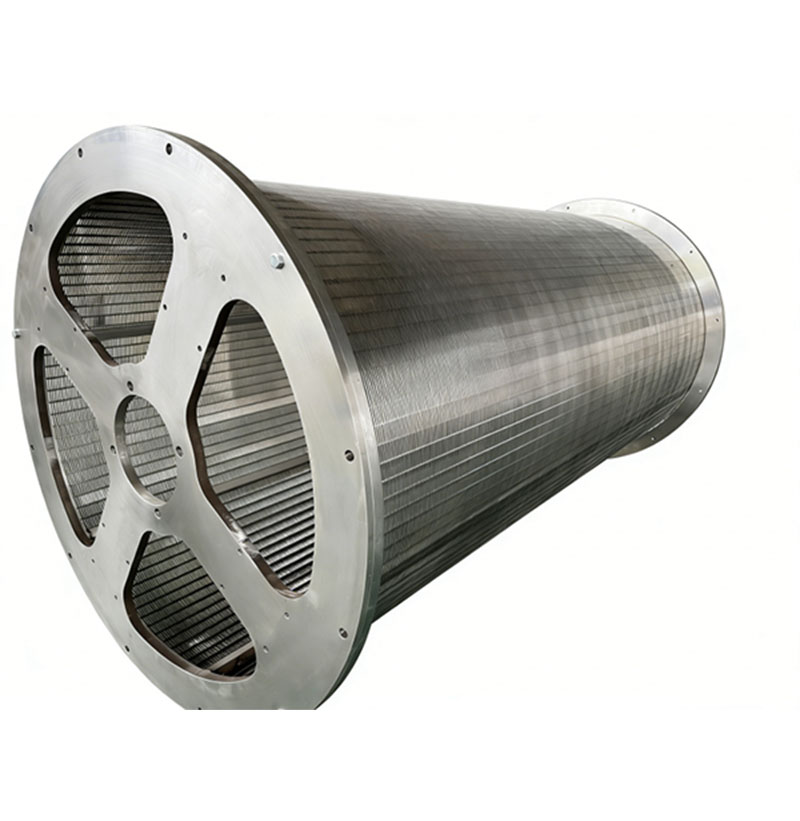
tambour rotatif
L'écran de tambour rotatif en acier inoxydable (également connu sous le nom de filtre de tambour rotatif ou micro-écran) est un dispositif de séparation solide-liquide frontal fonctionnant en continu et automatiquement. Son élément central est un grand tambour cylindrique installé horizontalement ou en légère inclinaison. Toute la surface circonférentielle du tambour est recouverte d'un écran en acier inoxydable (écran Johnson). Les eaux usées à traiter s'écoulent dans une extrémité du tambour. Sous la gravité, le filtrat passe à travers les fentes de fil de coin, tandis que la matière solide en suspension (telles que les fibres, les cheveux, les morceaux de plastique et les particules fines) est retenue sur la surface interne du tambour. Au fur et à mesure que le tambour tourne lentement, les débris retenus sont soulevés vers le haut, où ils sont rincés par l'eau pulvérisée dans un trou de collecte, permettant ainsi un processus continu de filtration automatique et d'élimination des résidus.
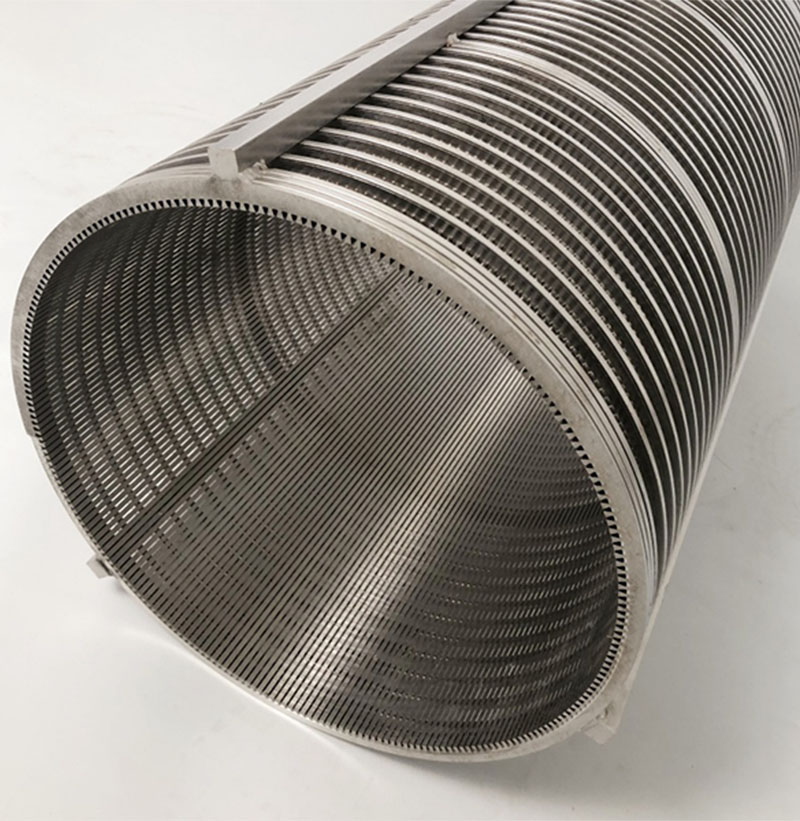
Panier d'écran pour séparateur de presse à vis
Le panier d'écran en fil de coin en acier inoxydable, communément connu sous le nom de "écran en V", "panier d'écran de presse" ou "cylindre d'écran", est un composant central des séparateurs solide-liquide de presse à vis. Il est installé à l'intérieur de la presse à spirale, encerclant l'arbre à vis rotatif. Le principe de fonctionnement est le suivant: la boue brute à forte teneur en humidité est poussée dans le panier d'écran par l'arbre à vis. Sous l'action de compression et de transport des vols en spirale, le liquide (filtrat) est forcé à travers les fentes précises et continues du panier d'écran, tandis que le matériau solide (gâteau de fumier) est retenu à l'intérieur et continue d'être comprimé et déshydraté au fur et à mesure qu'il avance. Enfin, les solides déshydratés sont déchargés de la sortie, permettant une séparation solide-liquide.
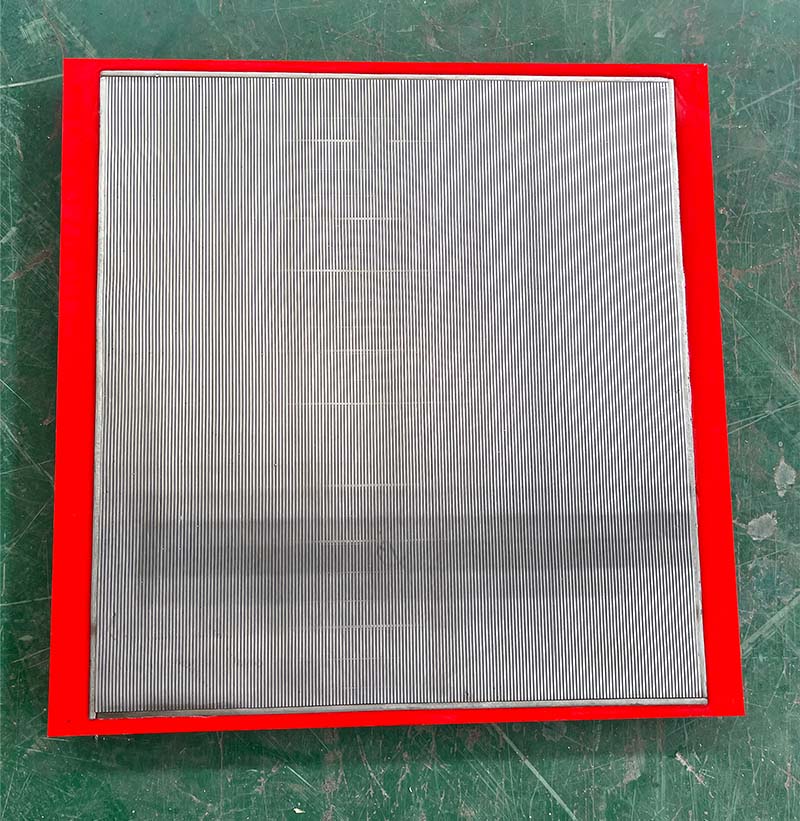
Ecran vibrant de fil de coin
Un écran vibrant en fil de coin en acier inoxydable est un dispositif de séparation solide-liquide comportant une surface d'écran réalisée par soudage précis de fils en acier inoxydable en forme de V, intégré à un système de vibration haute fréquence. Avec des fentes uniformes, une résistance à l'usure et une résistance à la corrosion, il convient aux opérations de filtrage humide et de déshydratation. Le mécanisme de vibration permet une dispersion rapide du matériau et un tamissage efficace tout en empêchant efficacement l'obstruction de l'écran. Largement utilisé dans des industries telles que l'exploitation minière, la métallurgie, la transformation des aliments et la protection de l'environnement, il est particulièrement adapté pour manipuler des particules fines, des matériaux à haute viscosité ou facilement agglomérables, offrant des avantages tels que la précision de criblage élevée, une grande capacité de traitement et une longue durée de vie.
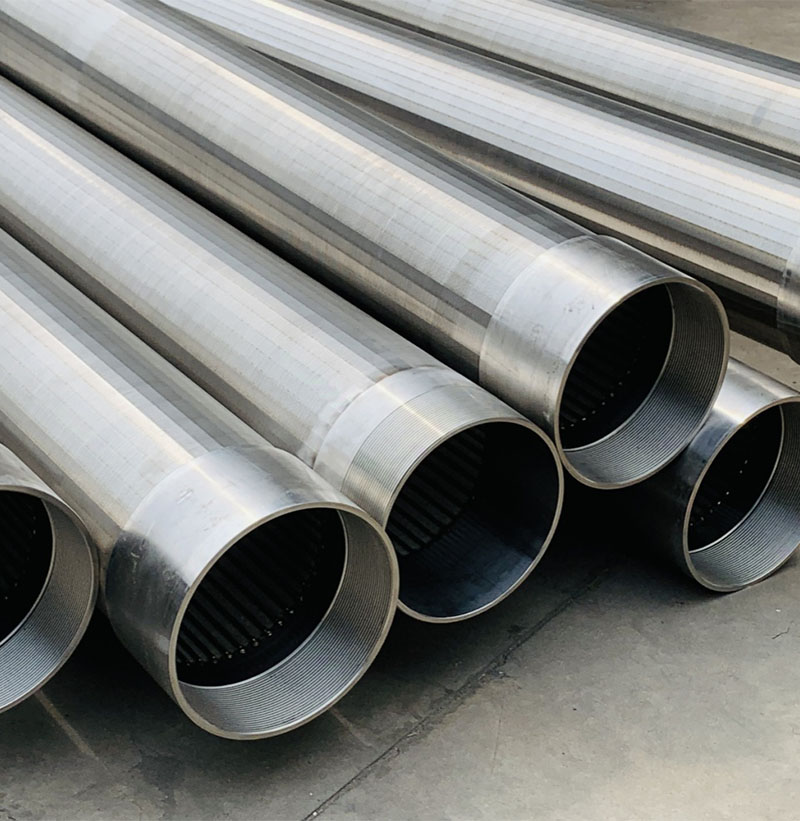
Écran de puits d'eau de fil de coin
Les écrans de puits d'eau profonde Johnson, également appelés écrans de fente continue ou écrans d'enveloppement de fil, ont été développés à l'origine pour résoudre les problèmes de contrôle du sable dans les formations de sable fine graine et uniforme. Ces conditions géologiques sont couramment rencontrées dans les aquifères souterrains profonds, où les tuyaux perforés conventionnels souffrent souvent d'obstruction, de production excessive de sable et de réduction de l'efficacité des puits.
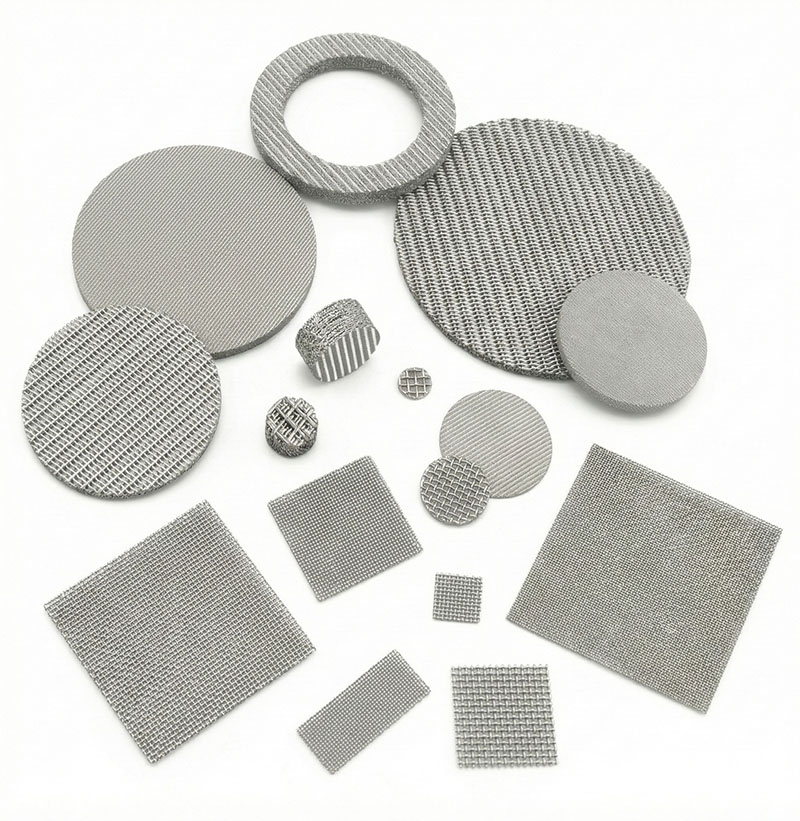
Plaque et disque en maille fritté
Les plaques et disques de maillage fritté sont des composants de filtration de haute précision fabriqués en liant plusieurs couches de maillage en acier inoxydable à travers un processus de frittage sous vide spécialisé. Contrairement au maillage traditionnel qui repose uniquement sur le tissage mécanique, ces plaques sont fusionnées à chaque point de contact, transformant des fils individuels en une tôle porouse rigide et intégrée.Ces plaques peuvent être personnalisées en différentes formes, le plus souvent des disques circulaires, pour s'adapter à des équipements industriels spécifiques. Ils offrent un équilibre idéal entre une perméabilité élevée, une intégrité structurelle extrême et des taux de filtration précis. Étant donné qu'ils sont entièrement en métal (généralement 304 ou 316L), ils fournissent une solution de filtration "permanente" qui peut résister aux températures élevées et aux produits chimiques corrosifs tout en restant entièrement nettoyables et réutilisables.